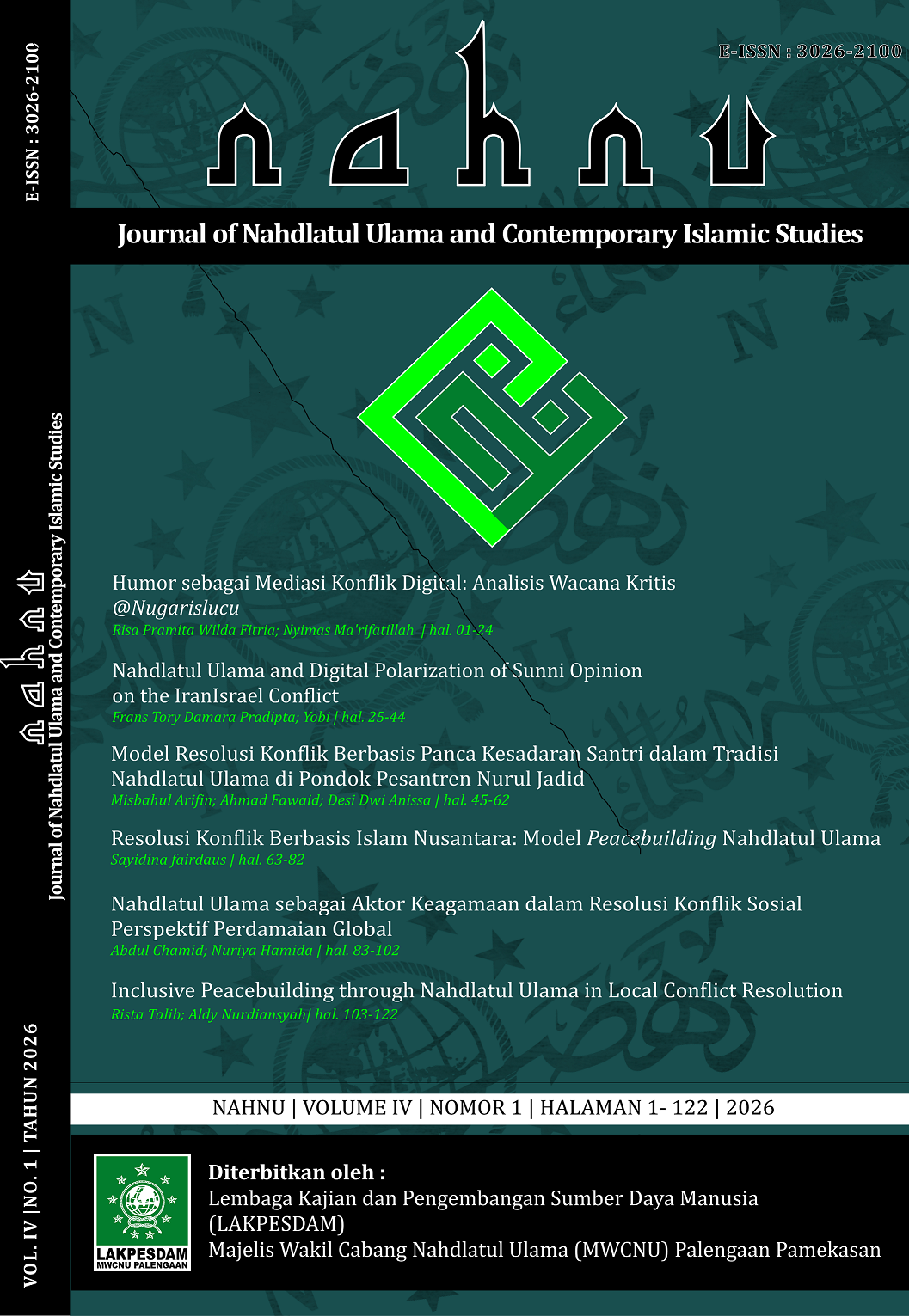
Nahdlatul Ulama sebagai Aktor Keagamaan dalam Resolusi Konflik Sosial Perspektif Perdamaian Global
Keywords:
Nahdlatul Ulama, , conflict resolution, global peacebuilding, Islamic soft power, wasatiyyahAbstract
This research aims to analyze and synthesize literature related to the role of Nahdlatul Ulama (NU) as a religious actor in the resolution of social conflicts from the perspective of global peace. This study uses a systematic literature review (SLR) approach with the adaptation of the PRISMA protocol. The results of the synthesis identify four central themes: first, the value of wasatiyyah (Islamic moderation) as an ideological foundation that is operationalized in conflict resolution practice; second, the role of NU as a multi-level mediator in communal conflicts in Indonesia; third, the transformation of NU into a global peacebuilding actor through the consolidation of the international network of moderate clerics; and fourth, the projection of NU's religious soft power in global peace governance. This study proposes a new concept of autonomous religious soft power to explain the unique capacity of moderate Islamic organizations to influence the dynamics of international peace without relying on state apparatus.
Penelitian ini bertujuan untuk menganalisis dan mensintesis literatur yang berkaitan dengan peran Nahdlatul Ulama (NU) sebagai aktor keagamaan dalam resolusi konflik sosial dari perspektif perdamaian global. Penelitian ini menggunakan pendekatan systematic literature review (SLR) dengan adaptasi protokol PRISMA. Kriteria inklusi penelitian mencakup publikasi ilmiah periode 1990–2024. Hasil sintesis mengidentifikasi empat tema sentral: pertama, nilai wasatiyyah (moderasi Islam) sebagai fondasi ideologis yang dioperasionalisasikan dalam praktik resolusi konflik; kedua, peran NU sebagai mediator multi-level dalam konflik komunal di Indonesia; ketiga, transformasi NU menjadi aktor peacebuilding global melalui konsolidasi jaringan ulama moderat internasional; dan keempat, proyeksi religious soft power NU dalam tata kelola perdamaian global. Kajian ini mengusulkan konsep baru autonomous religious soft power untuk menjelaskan kapasitas unik organisasi Islam moderat dalam mempengaruhi dinamika perdamaian internasional tanpa bergantung pada aparatur negara. Temuan ini berkontribusi pada pengembangan Islamic social thought, teori civil society berbasis agama, dan studi resolusi konflik dalam perspektif global.
References
Appleby, S R. The Ambivalence of the Sacred: Religion, Violence, and Reconciliation. Carnegie Commission on Preventing Deadly Conflict Series: Religion, Intenartional Studies. Bloomsbury Academic, 2000. https://books.google.co.id/books?id=8RqbMGvsz5MC.
Bruinessen, Martin Van. NU : Tradisi Relasi-Relasi Kuasa Dan Pencarian Wacana Baru. Edited by Farid Wajidi. Yogyakarta: LKis Yogyakarta, 1994.
Bush, Robin. Nahdlatul Ulama and the Search for a Modern Islamic Civilization. Pasir Panjang: ISEAS Publishing, 2009.
Creswell, John W, and Cheryl N Poth. Qualitative Inquiry and Research Design: Choosing Among Five Approaches. Edited by 4th Ed. Banten: SAGE Publications, 2018.
David Moher. “Preferred Reporting Items for Systematic Reviews and Meta-Analyses : The PRISMA Statement.” Open Medicine : A Peer-Reviewed, Independent, Open-Access Journal 3, no. 2 (2009): 123–30.
Fealy, G, and G Barton. Nahdlatul Ulama, Traditional Islam and Modernity in Indonesia. Monash Papers on Southeast Asia. Monash Asia Institute, 1996. https://books.google.co.id/books?id=eYSOAAAAMAAJ.
Fealy, Greg, and Greg Barton. Nahdlatul Ulama, Traditional Islam and Modernity in Indonesia. Clayton: Monash Asia Institute, 1996.
Fink, Arlene. Conducting Research Literature Reviews: From the Internet to Paper. 5th ed. SAGE Publications, 2019.
Galtung, Johan. “Violence, Peace, and Peace Research.” Journal of Peace Research 6, no. 3 (September 1, 1969): 167–91. https://doi.org/10.1177/002234336900600301.
Ginty, Roger Mac, and Oliver Richmond. “The Local Turn in Peace Building: A Critical Agenda for Peace," Third World Quarterly” 34, no. 5 (2013): 763–783. https://doi.org/10.1080/01436597.2013.800750.
Guba, Egon G, and Yvonna S Lincoln. “Competing Paradigms in Qualitative Research.” Handbook of Qualitative Research. Thousand Oaks, CA, US: Sage Publications, Inc, 1994.
Haas, Ernst B. “Knowledge, Power, and International Policy Coordination," International Organization” 46, no. 1 (1992): 1–35. https://doi.org/10.1017/S002081830000105X.
Hefner, R W. Civil Islam: Muslims and Democratization in Indonesia. Practical Guides in Psychiatry. Princeton University Press, 2000. https://books.google.co.id/books?id=tc6AcVGgLsEC.
Helmick, R G, and R Petersen. Forgiveness & Reconciliation: Public Policy & Conflict Transformation. Templeton Press, 2001. https://books.google.co.id/books?id=EtoQAQAAIAAJ.
Johnston, D, and C Sampson. Religion, the Missing Dimension of Statecraft. Oxford University Press, 1995. https://books.google.co.id/books?id=o7TAsFMSgEMC.
Keohane, R O, and J S Nye. Power and Interdependence: World Politics in Transition. Little, Brown, 1977. https://books.google.co.id/books?id=RmvuAAAAMAAJ.
Lederach, J P. Building Peace: Sustainable Reconciliation in Divided Societies. Building Peace: Sustainable Reconciliation in Divided Societies. United States Institute of Peace Press, 1997. https://books.google.co.id/books?id=54G6tlumdT0C.
Mietzner, M. Military Politics, Islam, and the State in Indonesia: From Turbulent Transition to Democratic Consolidation. Book Collections on Project MUSE. Institute of Southeast Asian Studies, 2009. https://books.google.co.id/books?id=_88w9S28ZkUC.
Moher, David, Alessandro Liberati, Jennifer Tetzlaff, and Douglas Altman. “Preferred Reporting Items for Systematic Reviews and Meta‐analyses: The PRISMA Statement.” Open Medicine : A Peer-Reviewed, Independent, Open-Access Journal 3, no. 2 (July 21, 2009): 123–30. https://doi.org/10.1016/j.jclinepi.2009.06.005.
Nye, J S. Soft Power: The Means To Success In World Politics. Soft Power: The Means to Success in World Politics. PublicAffairs, 2004. https://books.google.co.id/books?id=hTBxIMnpMloC.
Petticrew, M, and H Roberts. Systematic Reviews in the Social Sciences: A Practical Guide. Wiley, 2008. https://books.google.co.id/books?id=ZwZ1_xU3E80C.
Philpott, Daniel. “Explaining the Political Ambivalence of Religion.” The American Political Science Review 101, no. 3 (March 31, 2007): 505–25. http://www.jstor.org/stable/27644463.
Sholeh, Badrus. “Resolusi Konflik Di Asia Tenggara: Pengalaman Muslim Indonesia.” IAIN Tulungagung Research Collections 12, no. 1 (2017): 29–52.
Thomas, James, and Angela Harden. “Methods for the Thematic Synthesis of Qualitative Research in Systematic Reviews," BMC Medical Research Methodology” 8, no. 45 (2017). https://doi.org/10.1186/1471-2288-8-45.
Triguswinri, Krisnaldo. “Diskursus Ruang Publik Habermasian Dan Kebijakan Publik: Studi Literatur.” Pembangunan Dan Kebijakan Publik Universitas Diponegoro 7, no. 1 (2023): 637–42.
Downloads
Published
Issue
Section
License
Copyright (c) 2026 Abdul Chamid; Nuriya Hamida

This work is licensed under a Creative Commons Attribution-NonCommercial 4.0 International License.

This work is licensed under a Creative Commons Attribution-NonCommercial 4.0 International License.