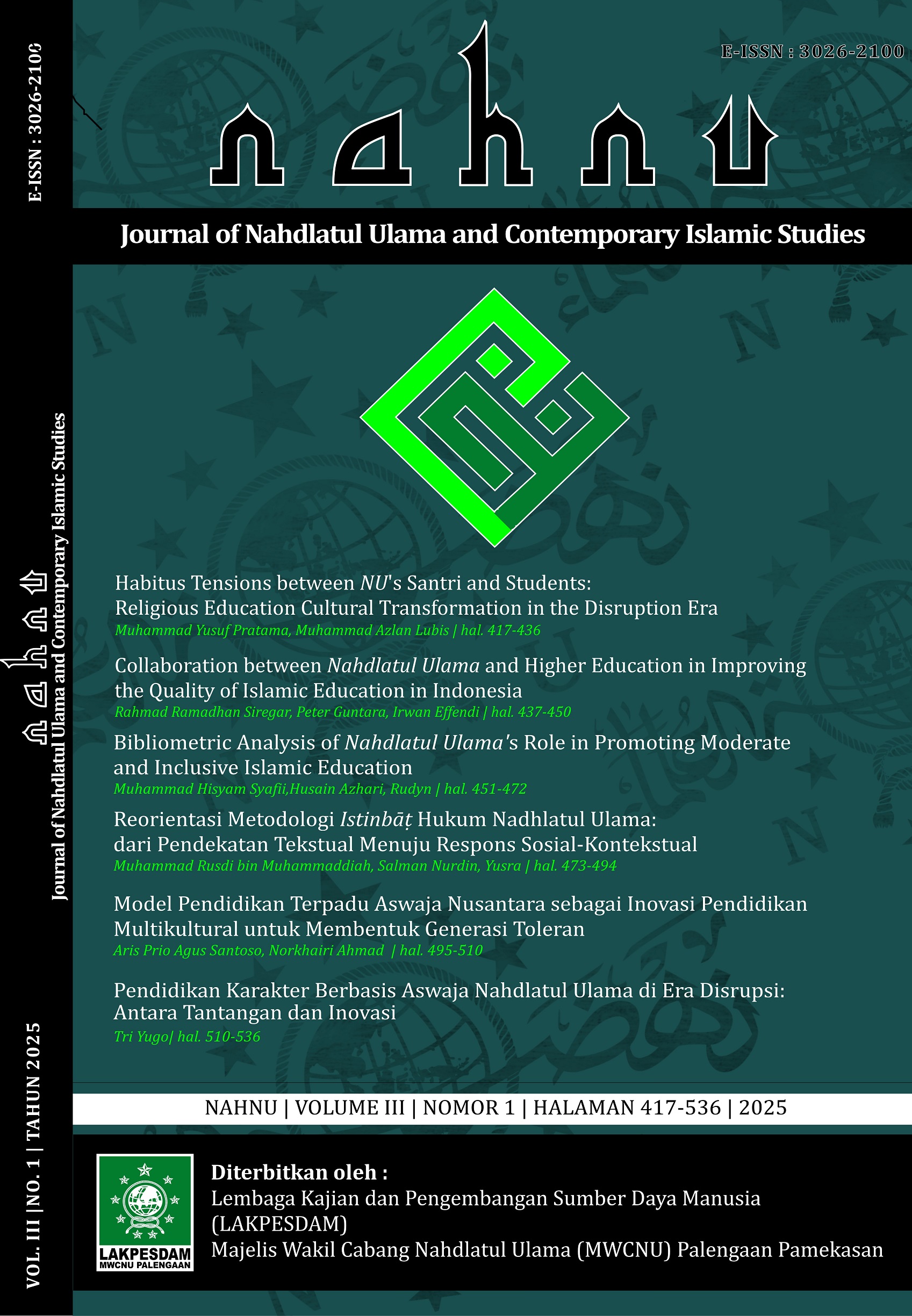
Reorientasi Metodologi Istinbāṭ Hukum Nadhlatul Ulama: dari Pendekatan Tekstual Menuju Respons Sosial-Kontekstual
DOI:
https://doi.org/10.63875/nahnu.v3i1.73Keywords:
Istinbāṭ Hukum, Fikih Sosial, Nahdlatul Ulama, Baḥtsul Masāʾil, Transformasi MetodologisAbstract
This research examines the transformation of legal istinbāṭ methodology within Nadhlatul Ulama (NU) from a textual approach to a contextual-adoptive approach. The study focuses on the dynamics of methodological change in the Baḥtsul Masāʾil forum and the implementation of social fiqh as a manifestation of this transformation. By using a qualitative-descriptive approach and the perspective of the sociology of Islamic law, this study aims to analyze the factors that encourage transformation, form of methodological change, and their impact on the relevance of contemporary Islamic law. The research findings show that the transformation of istinbāṭ methodology in NU took place gradually through the integration of textual-contextual approaches, which was strengthened by the birth of the idea of social fiqh. The Baḥtsul Masāʾil forum plays a strategic role in implementing this adaptive approach, although it still faces epistemological and methodological challenges. The research recommends the need to strengthen the capacity of scholars in social analysis, revitalize the classical scientific tradition, and develop an integrative methodological framework to ensure the sustainability of the transformation of adaptive istinbāṭ methodological in the future.
Penelitian ini mengkaji transformasi metodologi istinbāṭ hukum di lingkungan Nahdlatul Ulama (NU) dari pendekatan tekstual menuju pendekatan kontekstual-adaptif. Fokus kajian diarahkan pada dinamika perubahan metodologis dalam forum Baḥtsul Masāʾil dan implementasi fikih sosial sebagai manifestasi transformasi tersebut. Dengan menggunakan pendekatan kualitatif-deskriptif dan perspektif sosiologi hukum Islam, penelitian ini bertujuan menganalisis faktor-faktor yang mendorong transformasi, bentuk-bentuk perubahan metodologis, serta dampaknya terhadap relevansi hukum Islam kontemporer. Temuan penelitian menunjukkan bahwa transformasi metodologi istinbāṭ di NU berlangsung secara gradual melalui integrasi pendekatan tekstual-kontekstual, yang diperkuat dengan lahirnya gagasan fikih sosial. Forum Baḥtsul Masāʾil berperan strategis dalam mengimplementasikan pendekatan adaptif ini, meskipun masih menghadapi tantangan epistemologis dan metodologis. Penelitian merekomendasikan perlunya penguatan kapasitas ulama dalam analisis sosial, revitalisasi tradisi keilmuan klasik, dan pengembangan kerangka metodologis integratif untuk menjamin keberlanjutan transformasi metodologi istinbāṭ yang adaptif di masa depan.
References
Abdullah, M.M.A., and S.M.M. Mazahir. “Issuing Fatwa during Covid-19 Pandemic: An Analysis.” Sprin Journal of Arabic-English Studies 1, no. April (2022): 72–81. https://doi.org/10.55559/sjaes.v1i02.10.
Adib, Muhammad. “Bahtsul Masail Multidisipliner: Pembaruan Metodologis Ijtihad Kolektif NU.” Maqashid: Jurnal Hukum Islam 5, no. 1 (2022): 15–29. https://doi.org/10.35897/maqashid.v5i1.782.
Adinugraha, Hendri Hermawan, and Ahmad Hasan Asy’ari Ulama’i. “Understanding of Islamic Studies Through Textual and Contextual Approaches.” Farabi 17, no. 1 (2020): 26–48. https://doi.org/10.30603/jf.v17i1.1281.
Andrade, Chittaranjan. “The Inconvenient Truth About Convenience and Purposive Samples.” Indian Journal of Psychological Medicine 43, no. 1 (2021): 86–88. https://doi.org/10.1177/0253717620977000.
Ansori. “Position of Fatwa in Islamic Law: The Effectiveness of MUI, NU, and Muhammadiyah Fatwas.” Ijtihad: Jurnal Wacana Hukum Islam Dan Kemanusiaan 22, no. 1 (2022): 53–71. https://doi.org/10.18326/ijtihad.v22i1.53-71.
Arsadani, Qosim, Fathurrahman Djamil, Asep Saepudin Jahar, and M. Asrorun Niam Sholeh. “The Progressiveness of Sharia Economic Fatwas: Direction of Islamic Legal Thoughts within NU and Muhammadiyah.” Ahkam: Jurnal Ilmu Syariah 24, no. 1 (2024): 153–70. https://doi.org/10.15408/ajis.v24i1.37775.
Asni, Asni, Ashadi L. Diab, Kartini Kartini, and Kamarudddin Kamarudddin. “The Urgency of Transdisciplinary Approaches in Contemporary Islamic Law Studies.” KnE Social Sciences 2022 (2022): 615–22. https://doi.org/10.18502/kss.v7i8.10779.
Asofik, Mohammad Rifâ€TMan, and Ahmad Khafidh. “Breaking the Dullness of Thought Among Nahdliyin: The Genealogy of KH. Sahal Mahfudh’s Civilization Jurisprudence.” Tribakti: Jurnal Pemikiran Keislaman 34, no. 2 (2023): 245–66. https://doi.org/10.33367/tribakti.v34i2.3547.
Azharghany Rojabi. “Power Islamization: Unveiling the Islamicpolitics of Kiai As Leaders of the Indonesianpeople.” Al-Insyiroh: Jurnal Studi Keislaman 8, no. 1 (2022): 1–26.
Baroroh, Umdatul. “Understanding Methodology of Fiqh Sosial.” Santri: Journal of Pesantren and Fiqh Sosial 1, no. 1 (2020): 27–42. https://doi.org/10.35878/santri.v1i1.202.
Bobyreva, Ekaterina, Marina Zheltukhina, Kristina Korovina, and Maryana Busygina. “Religious Values in Global Communication of Modern Society: Trends in the Development and Transformation.” SHS Web of Conferences 69 (2019): 00021. https://doi.org/10.1051/shsconf/20196900021.
Bularafa, Bukar Ali, and Muhammad Alhaji Haruna. “Multi-Methods Approach in Entrepreneurship Research: Triangulation in Action.” Journal of Economics, Finance and Management Studies 05, no. 12 (2022): 3649–55. https://doi.org/10.47191/jefms/v5-i12-23.
Gillani, Aleem, Ateeq Ahmad Tariq, and Sana Ullah. “Conceptualizing Universal Human Rights in Islam: Implications in the Modern Period.” Global Sociological Review VIII, no. II (2023): 240–48. https://doi.org/10.31703/gsr.2023(viii-ii).25.
Hadi, Abdul, Nurul Azizah, and Nikmatus Sholihah. “Study Analysis Of Istinba Method ‘Nahḍatul’ Ulama’ (NU) In Marriage A Different Religion.” Sustainability (Switzerland) 11, no. 1 (2019): 1–14. https://doi.org/10.31942/TA.V6I2.3310.
Imawan, Dzulkifli Hadi. “Fiqih Sosial Dan Implementasi Zakat.” Ijtihad: Jurnal Hukum Dan Ekonomi Islam 16, no. 1 (2022): 19–39.
Jamaluddin, Samsidar, Hannani, Sunuwati, and Andi Muh. Taqiyuddin BN. “Istinbat Methodology in MUI, NU, and Muhammadiyah Fatwas: An Analysis of Classical Principles and Contemporary Adaptations Metodologi Istinbat Dalam Fatwa MUI, NU, Dan Muhammadiyah: Analisis Prinsip-Prinsip Klasik Dan Adaptasi Kontemporer” 2, no. 2 (2024): 115–30. https://doi.org/10.35905/marital_hki.v2i2.9472.
Jufri, Andi. “Islam and Strengthening Civil Society” 22, no. 2 (2022): 252–72. https://doi.org/https://doi.org/10.24252/jad.v22i2a5.
Juswandi, Juswandi. “The Urgency of Jurisprudence in Actualization Islamic Law.” PENA LAW: International Journal of Law 2, no. 1 (2023): 1–9. https://doi.org/10.56107/penalaw.v2i1.89.
Karman, Karman. “Discourse Analysis Approach and Its Use In The Investigation Of Social Injustice in Text Representation.” Komunika 10, no. 1 (2023): 72–79. https://doi.org/10.22236/komunika.v10i1.10178.
Lochmiller, Chad R. “Conducting Thematic Analysis with Qualitative Data.” Qualitative Report 26, no. 6 (2021): 2029–44. https://doi.org/10.46743/2160-3715/2021.5008.
Lorena, Tauany, and Alves Silva. “Subject Analysis , Content Analysis , and Domain Analysis : Concepts , Methods , and Applications” 47, no. 2 (2024). https://doi.org/10.5206/cjils-rcsib.v47i2.17633.
Lubis, Sahruddin, and Hari Zamharir. “Nahdlatul Ulama’s Fox Elite Fox Dei in Contemporary Indonesia: An Aborted Baby of Deliberative Democracy?” International Journal of Cultural and Religious Studies 2, no. 2 (2022): 46–52. https://doi.org/10.32996/ijcrs.2022.2.2.5.
Luintel, Youba Raj. “Epistemological Values and Limitations of Ethnography as an Interpretive Research Approach.” SCHOLARS: Journal of Arts & Humanities 2, no. August (2020): 83–90. https://doi.org/10.3126/sjah.v2i0.35016.
Marpaung, Watni, and M Amar Adly. “Discourse of Joint Property in Riview of Istinbath Islamic Law.” Al-Mashlahah Jurnal Hukum Islam Dan Pranata Sosial 10, no. 01 (2022): 257. https://doi.org/10.30868/am.v10i01.2453.
Meriem Attia Bouziane. “Semantic Issues of Hitting Women in the Quran Methodology: Resolving Reading Discrepancies.” Journal of Namibian Studies : History Politics Culture 33 (2023): 796–805. https://doi.org/10.59670/jns.v33i.758.
Muhamad Shadiq, Gusti, Jalaluddin Jalaluddin, Fathurrahman Azhari, and Fahmi Hamdi. “Telaah Metodologi Istinbath Dan Corak Hukum Islam Lembaga-Lembaga Fatwa Di Indonesia (LBMNU, Majelis Tarjih Muhammadiyah Dan Komisi Fatwa MUI).” Indonesian Journal of Islamic Jurisprudence, Economic and Legal Theory 2, no. 2 (2024): 684–99. https://doi.org/10.62976/ijijel.v2i2.546.
Muhammad Rijal Fadli. “Memahami Desain Metode Penelitian Kualitatif.” Humanika, Kajian Ilmiah Mata Kuliah Umum 21, no. 1 (2021): 33–54. https://doi.org/10.21831/hum.v21i1.
Mutakin, Ali. “Kitab Kuning Dan Tradisi Intelektual Nahdlatul Ulama (Nu) Dalam Penentuan Hukum (Menelisik Tradisi Riset Kitab Kuning).” Syariah Jurnal Hukum Dan Pemikiran 18, no. 2 (2018): 192. https://doi.org/10.18592/sy.v18i2.2270.
Nasution, Martua. “Arah Baru Metode Pembaharuan.” El-Ahli Jurnal Hukum Keluarga Islam 2, no. 2 (2021): 19–39. https://doi.org/https://doi.org/10.56874/el-ahli.v2i2.513.
Neville, Robert Cummings. “Philosophical Theology for a New Age.” Religions 14, no. 3 (2023). https://doi.org/10.3390/rel14030359.
Nurjanah, Rahmatsyah, and Ali Mutakin. “Fatwa Lajnah Bahtsul Masail NU Concerning Istibdâl Wakaf and Their Relevance with Renewal of Islamic Law.” Al-Istinbath: Jurnal Hukum Islam 7, no. 2 (2022): 509–30. https://doi.org/10.29240/jhi.v7i2.3707.
Pane, Ramadhan Siddik, and Sawaluddin Siregar. “Qiyas Sebagai Konstitusi Keempat Dalam Islam: Implementasi Qiyas Dalam Konteks Siyasah” 8 (2016): 1–23. https://doi.org/10.24952/el-qanuniy.v8i2.6224.
Pauzi, M., Darul Hipni, and Anwar M. Radiamoda. “The Importance of the Ijtihad Jama’I Method in Contemporary Fiqh Formulations.” Al-Risalah: Forum Kajian Hukum Dan Sosial Kemasyarakatan 23, no. 1 (2023): 13–20. https://doi.org/10.30631/alrisalah.v23i1.1322.
Amanda Perry-Kessaris. “Legal Design Could and Should Be More Sociolegal.” DRS2022: Bilbao, 2022, 0–11. https://doi.org/10.21606/drs.2022.281.
Ridwan, Auliya. “The Changing Roles of Ulama and the Evolution of Islamic Schools : Some Insights from Moroccan and Indonesian Cases Several Previous Studies Have Been Conducted on the Evolution of Islamic Education and the Role of Ulamas in Shaping It . One Such Study , ” 10, no. 2 (2022): 149–62. https://doi.org/https://doi.org/10.15642/jpai.2022.10.2.149-162.
Saadah, Nairi, M. Hasbi Umar, and Ramlah. “Hukum Islam Dan Dinamika Sosial (Analisis Metode Penemuan Hukum Islam Kontekstual.” Jurnal Indragiri Penelitian Multidisiplin 2, no. 1 (2022): 10–16.
Saepulah, Saepulah, Lina Marlina, and Unang Fauzi. “The Dynamics of the Role of the Nahdlatul Ulama Social Movement in Responding to Social Change.” International Journal of Islamic Khazanah 10, no. 1 (2020): 17–33. https://doi.org/10.15575/ijik.v10i1.8418.
Siregar, Muhammad Habibi. “Scheme of Maslahat Within Sharia and Transcendental Fiqh.” Ijtihad : Jurnal Hukum Dan Ekonomi Islam 15, no. 1 (2021): 35–62. https://doi.org/10.21111/ijtihad.v15i1.4672.
Soraya, Serin Himatus, and Wahyu Tri Wibowo. “Construction of Public Opinion about Religious Moderation on NU Online Instagram Accounts (@nuonline_id).” KOMUNIKA: Jurnal Dakwah Dan Komunikasi 15, no. 1 (2021): 111–23. https://doi.org/10.24090/komunika.v15i1.4572.
Sulthon, Muhammad. “Methodology and Scope of Social Fiqh (Thinking Study KH. M. Sahal Mahfudh).” Jurnal Dinamika Hukum 19, no. 3 (2020): 569. https://doi.org/10.20884/1.jdh.2019.19.3.2580.
Suminto, Ahmad, and Sisminawati. “Uṣūl Al-Fiqh Sebagai Metode Penggali Hukum Syarak” 2, no. 1 (2020): 1–20. https://doi.org/10.21154/SYAKHSIYYAH.V2I1.2157.
Syafi’i, Imam. “Nalar Moderat Istinbat Al-Ahkam Nahdlatul Ulama.” Proceedings of Annual Conference for Muslim Scholars 6, no. 1 (2022): 988–1002. https://doi.org/10.36835/ancoms.v6i1.352.
Syahir, Ahmad, Jalaluddin Jalaluddin, Fathurrahman Azhari, and Fahmi Hamdi. “Pendekatan Filosofis, Sosiologis, Dan Antropologis Dalam Penetapan Hukum Islam (Sebuah Pendekatan Sosial-Humanities).” Indonesian Journal of Islamic Jurisprudence, Economic and Legal Theory 2, no. 2 (2024): 958–74. https://doi.org/10.62976/ijijel.v2i2.582.
Syakur, Muhammad, Ratno Lukito, and Moh Tamtowi. “Inter Subjectivity of Fatwa Results of The Decision of Bahtsul Masail NU On The Status of Non-Muslim Citizenship Muhammad” 21, no. 2 (2022): 58–75. https://doi.org/https://doi.org/10.31941/pj.v21i2.2666.
Tóth, Zoltán J. “Excerpts From the Development of Methods of Legal Interpretation.” Law, Identity and Values 2, no. 1 (2022): 241–64. https://doi.org/10.55073/2022.1.241-264.
Wasman, Mesraini, and Suwendi. “A Critical Approach To Prophetic Traditions: Contextual Criticism in Understanding Hadith.” Al-Jami’ah 61, no. 1 (2023): 1–17. https://doi.org/10.14421/ajis.2023.611.1-17.
Wiryanto, Fadhli Suko. “The Urgency and Strategic Role of Maqasid Shari’ah and Maslahah in Responding to The Legal and Economic Challenges of Muslim Business.” Jurnal of Middle East and Islamic Studies 10, no. 1 (2023). https://doi.org/10.7454/meis.v10i1.158.
Downloads
Published
Issue
Section
License
Copyright (c) 2025 Muhammad Rusdi bin Muhammaddiah, Salman Nurdin, Yusra Umami

This work is licensed under a Creative Commons Attribution-NonCommercial 4.0 International License.

This work is licensed under a Creative Commons Attribution-NonCommercial 4.0 International License.