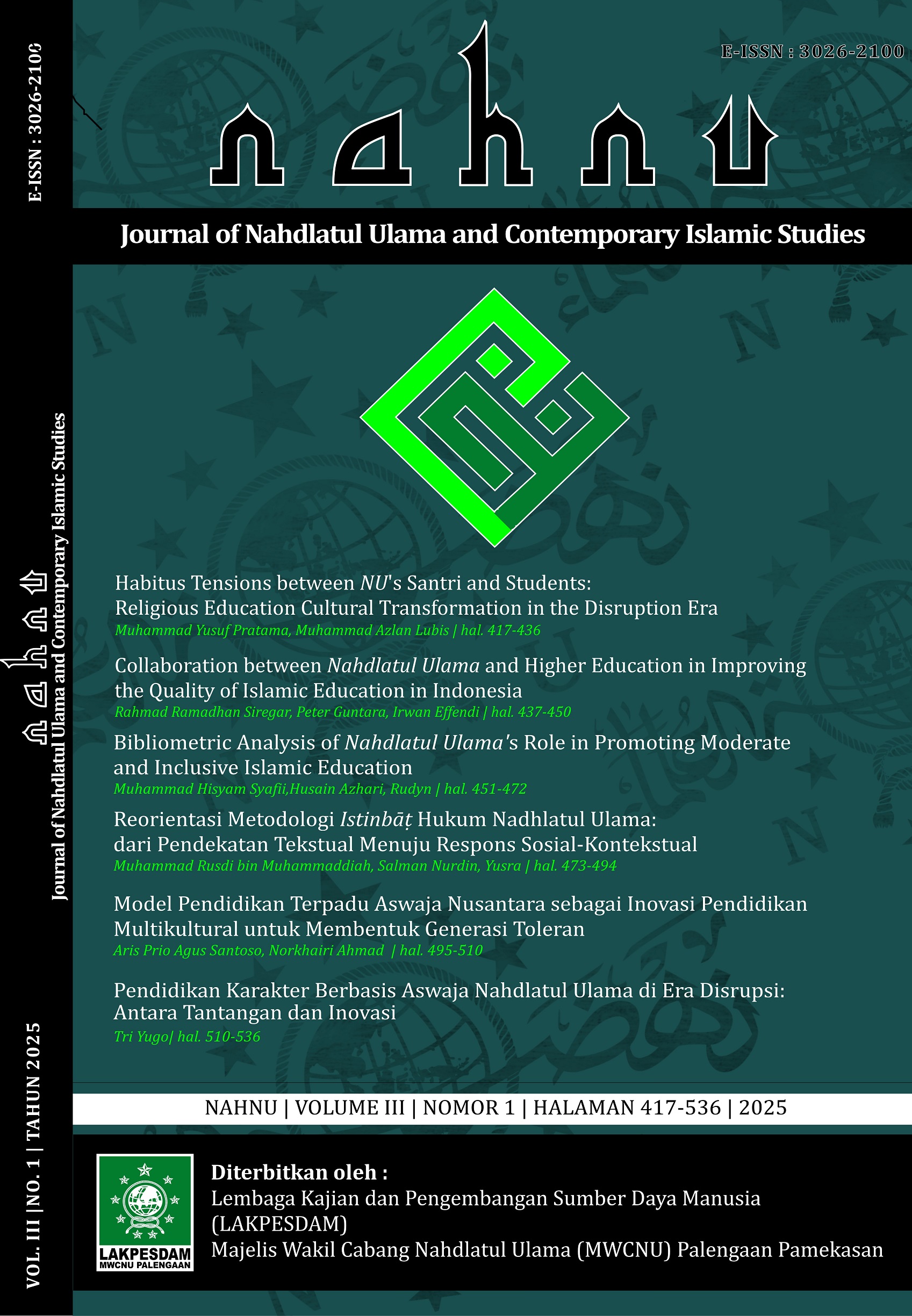
A Bibliometric Analysis of Nahdlatul Ulama’s Role in Promoting Moderate and Inclusive Islamic Education
DOI:
https://doi.org/10.63875/nahnu.v3i1.88Keywords:
Nahdlatul Ulama, pendidikan Islam, moderasi Islam, pedagogi wasathiyyahAbstract
This study investigates the intellectual contribution of Nahdlatul Ulama to the development of moderate Islamic educational epistemology during the period 1990-2024 using a comprehensive bibliometric approach. The results show a paradigmatic shift from the classical knowledge transmission approach to an inclusive epistemological framework that combines revealed knowledge, rational reasoning, and the wisdom of the masters. Between 2010 and 2015, the concept of neo-ijtihad as a reconstructive methodology emerged. The intellectual structure shows that figures from the National University have built a broad academic collaboration network, strengthening their epistemological position in global discourse. According to the study, NU has succeeded in developing an epistemology of Islamic education that overcomes the dichotomy between tradition and modernity by using contextual hermeneutics.
Studi ini menyelidiki kontribusi intelektual Nahdlatul Ulama terhadap perkembangan epistemologi pendidikan Islam moderat selama periode 1990-2024 dengan menggunakan pendekatan bibliometrik komprehensif. Hasilnya menunjukkan pergeseran paradigmatis dari pendekatan transmisi pengetahuan klasik menuju kerangka epistemologi inklusif yang menggabungkan pengetahuan wahyu, penalaran rasional, dan kebijaksanaan. Struktur intelektual menunjukkan bahwa tokoh-tokoh dari Universitas Nasional telah membangun jaringan kerja sama akademik yang luas, yang memperkuat posisi epistemologi mereka dalam diskursus global. NU berhasil mengembangkan epistemologi pendidikan Islam yang mengatasi dikotomi antara tradisi dan modernitas dengan menggunakan hermeneutika kontekstual. Ini menawarkan opsi untuk mengatasi polarisasi dalam pendidikan agama dan memberikan kontribusi signifikan untuk pengembangan pendidikan Islam inklusif di era modern.
References
Adiyono, Adiyono, Syamsun Ni'am, and Akhyak Akhyak. "Methodology of Islamic Studies: Islam as Religion (A Perspective Epistemology, Paradigm, and Methodology)." Analisis: Jurnal Studi Keislaman 24, no. 1 (2024): 169-200.
Akinsanya, Patrick O., and Anthony Ojoka Ojotule. "Freire’s critical pedagogy and professional teaching in the twenty-first century." UNIZIK Journal of Educational Research and Policy Studies 14, no. 3 (2022): 145-160.
Alabdulhadi, Maali Mohammed Jassim, and Kalthoum Mohammed Alkandari. "Practices of Islamic education teachers in promoting moderation (wasatiyyah) values among high school students in Kuwait: challenges and obstacles." Cogent Education 11, no. 1 (2024): 2365577.
Al-Jayyousi, Odeh Rashed. Islam and sustainable development: New worldviews. Gower, 2016.
Basid, Abdul, Moh Fauzan, Amrulloh Amrulloh, Mujianto Solichin, Ahmad Munjin Nasih, and Bakri Mohamed Bkheet Ahmed. "The Role of Nahdlatul Ulama’(NU) Diplomacy in Promoting Islam Rahmatan Lil ‘Alamin Exegesis to Strengthen Indonesian State-Religion Concepts: A Study of Gus Dur's Thought." Journal of Islamic Thought and Civilization 14, no. 2 (2024): 224-245.
Burakgazi, Sevinç Gelmez. "The ecological model of human development." In Exploring Adult Education Through Learning Theory, pp. 325-342. IGI Global, 2025.
Falaah, Shamsul. "Islamic Shari’ah and the Rights of Women: The Maldives’ Thirst for International Human Rights Norms of Equality and Non-Discrimination." Muslim World Journal of Human Rights 13, no. 1 (2016): 101-130.s
Freire, Paulo. "The banking concept of education." In Thinking about schools, pp. 117-127. Routledge, 2018.
Graham, Sandra, and April Z. Taylor. "Attribution theory and motivation in school." In Handbook of motivation at school, pp. 11-33. Routledge, 2016.
Gutiérrez-Salcedo, María, M. Ángeles Martínez, José Antonio Moral-Munoz, Enrique Herrera-Viedma, and Manuel J. Cobo. "Some bibliometric procedures for analyzing and evaluating research fields." Applied intelligence 48 (2018): 1275-1287.
How, Alan R., and Alan R. How. "The Hermeneutic Approach." Restoring the Classic in Sociology: Traditions, Texts and the Canon (2016): 151-185.
Jain, Jinesh, Nidhi Walia, Simarjeet Singh, and Esha Jain. "Mapping the field of behavioural biases: A literature review using bibliometric analysis." Management Review Quarterly (2021): 1-33.
Khan, Rahmat Ullah, Nauman Sadiq, Amjad Hussain Bhatti, and Muhammad Waqas. "Multiple Intelligences as a Framework for Students’ Holistic Development: Analysis and Way Forward." Annual Methodological Archive Research Review 3, no. 4 (2025): 491-501.
Marjani, Gustiana Isya. "The Evolution of Islam Nusantara: Tracing the Origins and Examining Contemporary Manifestations of Pluralism and Tolerance." International Journal of Nusantara Islam 11, no. 1 (2023): 121-135.
Mezirow, Jack. "Transformative learning theory." In Contemporary theories of learning, pp. 114-128. Routledge, 2018.
Moslimany, Raqib, Anzar Otaibi, and Frugo Shaikh. "Designing a holistic curriculum: Challenges and opportunities in islamic education." Journal on Islamic Studies 1, no. 1 (2024): 52-73.
Musyarrofah, Umi, and Zulhannan Zulhannan. "Religious moderation in the discourse of Nahdlatul Ulama’s dakwah in the era of industry 4.0." Millah: Journal of Religious Studies (2023): 409-434.
Novita, Almi. "A Century of Nadhlatul Ulama’s Contribution to Modernizing Islamic Education in Indonesia." Jurnal Pendidikan Agama Islam (Journal of Islamic Education Studies) 11, no. 1 (2023): 17-26.
Palekhov, Dmitry, Ludmila Palekhova, Michael Schmidt, and Berthold Hansmann. "A Paradigm Shift in University Education Towards Sustainable Development." Sustainable Global Value Chains (2019): 709-730.
Prabakaran, Madhu. "Harmonizing teaching and learning: Reconciling schooling and education with civilizational dialectics." Outcome Based Education and Research: A Multidisciplinary Approach. Ram Niwas Sharma (Ed.) by National Law School and Judicial Academy, Assam (2024).
Qadri, Shah Sahin, Nasir Shaheen Hussin, and Mezirow Mursaleen Dar. "Countering extremism through islamic education: Curriculum and pedagogical approaches." Journal on Islamic Studies 1, no. 1 (2024): 74-89.
Rabbani, Lutfieh Mohammad, Khaleel Shehadeh Alarabi, Najeh Rajeh Alsalhi, and Hanan Sa’deh Al Marashdi. "Behaviourist vs. Constructivist views of feedback: Provisions and implications." Arts Educa 36 (2023).
Rahman, Gohar. "Reconstructing Islamic Identity in Modern Times: A Narrative Review of Educational Reform and Intellectual Responses." Sinergi International Journal of Islamic Studies 3, no. 1 (2025): 29-43.
Ritonga, Mahyudin, and Riki Saputra. "Epistemology of Knowledge: Bridging Western and Islamic Thought." Solo International Collaboration and Publication of Social Sciences and Humanities 3, no. 01 (2025): 95-110.
Rosidah, Feryani Umi, and Nur Faizah. "Strengthening Nadhatul Ulama as Moderate Islam in the Digital Era." Qomaruna Journal of Multidisciplinary Studies 1, no. 2 (2024): 103-111.
Rosidah, Feryani Umi, and Nur Faizah. "Strengthening Nadhatul Ulama as Moderate Islam in the Digital Era." Qomaruna Journal of Multidisciplinary Studies 1, no. 2 (2024): 103-111.
Sahin, Abdullah. "Critical issues in Islamic education studies: Rethinking Islamic and Western liberal secular values of education." Religions 9, no. 11 (2018): 335.
Sahin, Abdullah. "Islam, Muslims and education: Framing an interdisciplinary field of research, critical scholarship and professional practice." The Muslim World Book Review 40, no. 1 (2019): 6-29.
Salendra, I. Wayan. "Religious Moderation in Digital Media Discourse: A Study of the nu. or. id Portal from the Perspective of Communicative Rationality." Fikri: Jurnal Kajian Agama, Sosial dan Budaya 9, no. 2 (2024): 200-220.
Siswanto, Siswanto, Ahmad Fawaid, and Saiful Hadi. "Learning Islamic Moderation In Pesantren: The Construction of Kiai’s Thought about Islamic Moderation and Its Implication on The Students’ Behavior." Islamuna: Jurnal Studi Islam 11, no. 2 (2024): 121-138.
Sweller, John. "Cognitive load theory and educational technology." Educational technology research and development 68, no. 1 (2020): 1-16.
Syafi'i, Muhammad Hisyam, and Adi Mulya. "Literature Study on the Impact of Congregational Morning Prayer on Academic Anxiety: A View on Psychospiritual and Psychoneuroimmunology in Students." Journal of Islamic Communication and Counseling 3, no. 1 (2024): 72-90.
Taber, Keith S., and Xinyue Li. "The vicarious and the virtual: A Vygotskian perspective on digital learning resources as tools for scaffolding conceptual development." Advances in psychology research 143 (2021): 1-72.
Utari, Utari, Syazarah Soraya, and Yuni Wulandari. "The gradual Islamisation of teacher education: Current trends and future implications in global inclusive education policy." Journal on Islamic Studies 1, no. 1 (2024): 1-16.
Uyuni, Badrah, and Mohammad Adnan. "Philosophical Foundations in Training Traditional Religious Educators: Bridging Past and Present." Futurity Philosophy 3, no. 2 (2024): 40-65.
Zwoliński, Grzegorz, and Dorota Kamińska. "Flowing Through Virtual Realms: Leveraging Artificial Intelligence for Immersive Educational Environments." In International Conference on Artificial Intelligence in Education, pp. 44-57. Cham: Springer Nature Switzerland, 2024.
Downloads
Published
Issue
Section
License
Copyright (c) 2025 Hisyam Syafii, Husain Azhari, Rudyn alaldaya

This work is licensed under a Creative Commons Attribution-NonCommercial 4.0 International License.

This work is licensed under a Creative Commons Attribution-NonCommercial 4.0 International License.